
Soft inquiries do not affect your credit score, while hard inquiries can lower it by a few points. For mortgage pre-qualification, soft inquiries are the standard and safest starting point. Infinite Home Lending uses soft pulls to provide initial estimates without impacting your credit profile. This approach allows you to explore options in Maryland, DC, and Virginia with zero risk to your score.
Understanding Soft Credit Inquiries
A soft inquiry is a credit check that does not impact your credit score. These checks are typically performed by you, your employer, or a lender for pre-qualification purposes. When you use a mortgage calculator or request a pre-qualification letter, the lender performs a soft pull. This allows them to see your credit history and estimate your eligibility without leaving a mark on your report. Soft inquiries are invisible to other lenders and do not signal that you are actively seeking new credit.
When Soft Inquiries Are Used
Soft inquiries occur during pre-qualification, account reviews, and rate checks. They are also used when you check your own credit score. Because they do not affect your score, you can perform as many soft inquiries as you like without penalty. This makes them ideal for early-stage research and comparison shopping.
Understanding Hard Credit Inquiries
A hard inquiry is a credit check that can lower your credit score by a few points. These checks occur when you apply for new credit, such as a mortgage, credit card, or auto loan. Lenders perform hard pulls to verify your creditworthiness for a formal application. While the impact is usually small and temporary, multiple hard inquiries in a short period can signal financial stress to future lenders. Hard inquiries remain on your credit report for two years but only affect your score for one year.
When Hard Inquiries Are Used
Hard inquiries happen during pre-approval, formal loan applications, and credit card applications. Pre-approval is a more rigorous process than pre-qualification and requires a hard pull. It provides a stronger signal to sellers that you are a serious buyer. However, it does carry a small risk to your credit score. You should only proceed to pre-approval when you are ready to make an offer.
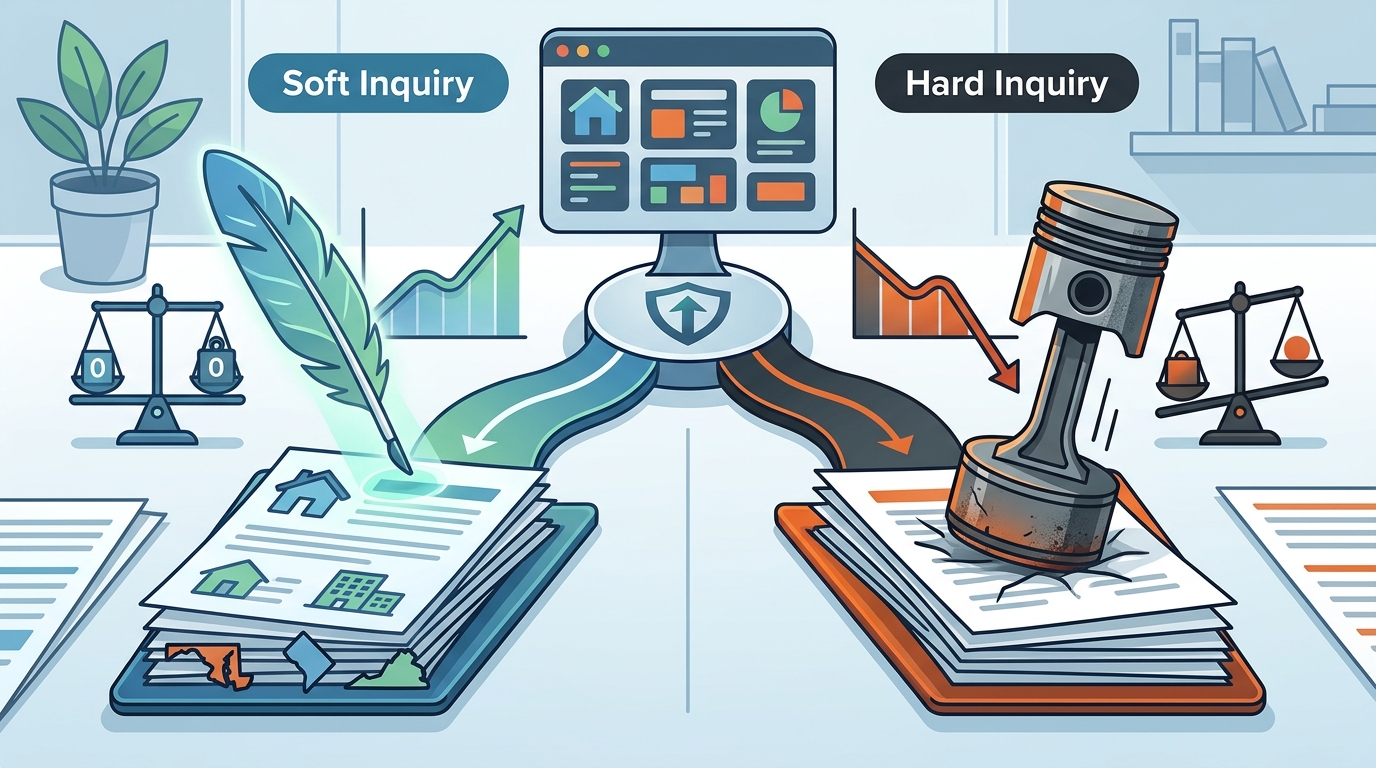
Comparison Table: Soft vs. Hard Inquiries
| Criteria | Soft Inquiry | Hard Inquiry |
|---|---|---|
| Impact on Credit Score | No impact | May lower score by 5-10 points |
| Visibility to Other Lenders | Invisible | Visible for 2 years |
| Typical Use Case | Pre-qualification, rate checks | Pre-approval, formal applications |
| Accuracy of Estimate | General estimate | Specific, binding offer |
| Risk Level | Zero risk | Low but non-zero risk |
| Best For | Early research, comparison | Ready to make an offer |
Choosing the Right Inquiry Type
Choose a soft inquiry if you are in the early stages of homebuying and want to understand your options without any risk to your credit score. This is the best approach for comparing lenders, estimating your budget, and exploring loan programs. It allows you to gather information and make informed decisions before committing to a formal application.
Choose a hard inquiry if you are ready to make a competitive offer on a home and need a strong pre-approval letter. Sellers and real estate agents view pre-approval as a sign of financial readiness. The small, temporary impact on your score is usually outweighed by the competitive advantage it provides in a hot market like the DMV area.
Frequently Asked Questions
Does a soft inquiry show up on my credit report?
Soft inquiries may appear on your credit report, but they are not visible to other lenders. They do not affect your credit score and are generally ignored by underwriters when evaluating your application.
How much does a hard inquiry lower my credit score?
A hard inquiry typically lowers your credit score by 5 to 10 points. The exact impact depends on your overall credit profile and the number of recent inquiries. For most borrowers, the impact is minimal and temporary.
Can I get pre-approved without a hard inquiry?
Do multiple mortgage inquiries count as one?
Yes, most credit scoring models group multiple mortgage inquiries within a 14-45 day window as a single inquiry. This allows you to shop around for the best rate without taking multiple hits to your score. The same grouping applies to auto loans and student loans.
How long does a hard inquiry stay on my report?
A hard inquiry remains on your credit report for two years. However, it only affects your credit score for one year. After that, it remains visible but has no impact on your score.
Is it safe to check my own credit score?
Yes, checking your own credit score is a soft inquiry and does not affect your score. You can check your score as often as you like without any negative consequences. This is a good habit to maintain before applying for a mortgage.
Start Your Mortgage Journey Safely
Understanding the difference between soft and hard inquiries is the first step in protecting your credit while exploring your mortgage options. Infinite Home Lending provides clear guidance on when to use each type of inquiry, ensuring you make informed decisions at every stage of your homebuying journey. To begin your pre-qualification with a soft inquiry, start your pre-approval process today.